Is The Lowry Free? Galleries Vs Theatre Tickets
The Lowry splits cleanly in two: an art collection anyone can walk into for nothing, and a theatre programme that always sells tickets.
Short answer
Yes, the Lowry art galleries are free to enter, including the L.S. Lowry collection, but the theatre performances inside the same building are separately ticketed and paid.
The Lowry's art galleries are genuinely free to enter, including the L.S. Lowry collection, and no booking is needed to see them. The theatres inside the same building are a different matter entirely: every performance, from pantomime to West End transfers, is separately ticketed and paid. The building sits at Salford Quays, about fifteen minutes from Manchester city centre by tram, surrounded by free waterfront walking.
That single split, free galleries and paid theatres under one roof, is the honest answer to the question, and it is the reason this page exists. Plenty of Manchester's headline attractions carry a hidden condition. The Lowry does not hide its condition so much as spread it across two very different halves of one building. A visitor who arrives expecting a free art gallery gets one. A visitor who arrives expecting a free musical does not, and no signage inside the building pretends otherwise.
The distinction matters most for people planning a budget day out at the Quays, because The Lowry anchors the whole area. It sits beside the water at the end of the former Manchester Docks, opposite the Imperial War Museum North, with the MediaCityUK studios a short walk along the quayside. Almost everything outdoors around it costs nothing. The building itself is half free, half not, and the table below shows exactly where the line falls.
| What | Cost | Condition |
|---|---|---|
| The Lowry art galleries, including the L.S. Lowry collection | Free | Open Tuesday to Friday 11am to 5pm, Saturday, Sunday and bank holidays 10am to 5pm, closed Mondays except bank holidays |
| Theatres and studios at The Lowry (Lyric Theatre, Quays Theatre) | Paid | Every performance is separately ticketed; prices vary by show and seat |
| Tours of The Lowry building | Check with the venue | Availability and any charge depend on the current programme |
| IWM North, five minutes along the water | Free | General admission free |
| The Quays waterfront and MediaCityUK public realm | Free | Open public space at all times |
For visitors who want the story behind the Quays and the city that built them rather than just the postcode, there is a free way to get it. The featured walks below are all pay what you want tours run by independent local guides on GuruWalk, a platform that lists free tours in cities worldwide. None of them belongs to this site. Each one is tipped at the end, at whatever amount the walker decides, and the figures quoted come straight from the platform's own review listings.
The four walks in that band are the English-language walks featured on this site, drawn from a Manchester inventory of six free tours in total. The 3-Hour Walking Tour is the flagship, rated 4.96 out of 5 across 1,276 GuruWalk reviews. The World-Famous Dog Salchicha Tour, 4.96 out of 5 across 271 GuruWalk reviews, is guided in both English and Spanish and built around a guide and her dog. The BBC And Sidemen Tour, 4.8 out of 5 across 256 GuruWalk reviews, leans into the city's internet-famous side. The Radical History Tour, a perfect 5 out of 5 across 23 GuruWalk reviews, digs into the political Manchester that changed the world. A fifth GuruWalk listing, the Express Tour In Spanish, runs in Spanish only, and a Standard Free Walking Tour listed on freetour.com rounds out the six; that one is named here for honesty but carries no link from this site.
What Can You See Inside The Lowry Galleries For Free?
The free half of The Lowry is substantial, and it is not a corridor with a few prints bolted to the wall. The galleries hold the largest public collection of works by L.S. Lowry anywhere, built around the Lowry Family Collection and the genuinely large holdings acquired over decades. Alongside the permanent displays there is a rolling programme of temporary exhibitions in the gallery spaces, all of it inside the free entry. The venue's own visit planning page sets out the current gallery offer, and the free entry is stated plainly there alongside the theatre ticketing.
The galleries have a generous hang. Lowry's industrial scenes, the matchstalk figures and smoking chimneys that made him famous, sit alongside his portraits and quieter seascapes, plus work by other artists in the temporary spaces. Anyone expecting a small commemorative room will be surprised by the floor area the collection occupies. Photography without flash is normally welcome in the galleries, and the galleries sit across two floors with lifts, so access is straightforward.
The hours are the one condition worth remembering, and the table above carries them: closed Mondays except bank holidays, later opening on weekdays, earlier at weekends. Turn up on a Monday expecting the Lowry collection and the doors to the galleries will be shut, though the building's foyers, bars and box office are usually open on performance days. The condition is small but real, and it belongs in the same breath as the free claim.
How Much Do Theatre Tickets At The Lowry Cost?
The honest answer is that theatre tickets at The Lowry are priced per show and per seat, and no figure on this page would survive the next season brochure. The Lyric Theatre and the Quays Theatre host touring musicals, drama, comedy, dance and the annual Christmas pantomime, plus studio shows in the smaller spaces. Ticket prices swing widely between a midweek matinee and a Saturday night for a West End transfer. What is certain, and what this site can state as fact, is that none of it is free and none of it is pay what you want.
That is worth saying plainly because the word "free" gets attached to The Lowry so often that some visitors assume the whole venue works that way. It does not. The Lowry is a producing and receiving house with a box office, and every seat in the theatres is sold. Concessions, group rates and occasional access schemes exist, run by the venue itself, but those are discounts on a paid product rather than free entry. Checking the current programme on the venue's own site before planning a theatre visit is the practical move, since shows and prices change faster than any guide page can track.
The free-hill-and-paid-tower pattern repeats across Manchester's cultural buildings, and The Lowry is its cleanest example. Manchester Art Gallery charges nothing at the door. The People's History Museum charges nothing but suggests a donation. The National Football Museum charges most of England and waives only residents. The Lowry splits itself down the middle in a single building, which at least makes the boundary easy to walk past. A family can see world class art for nothing, then spend serious money two floors up on the same afternoon.
Is The Lowry The Same As The Lowry Centre?
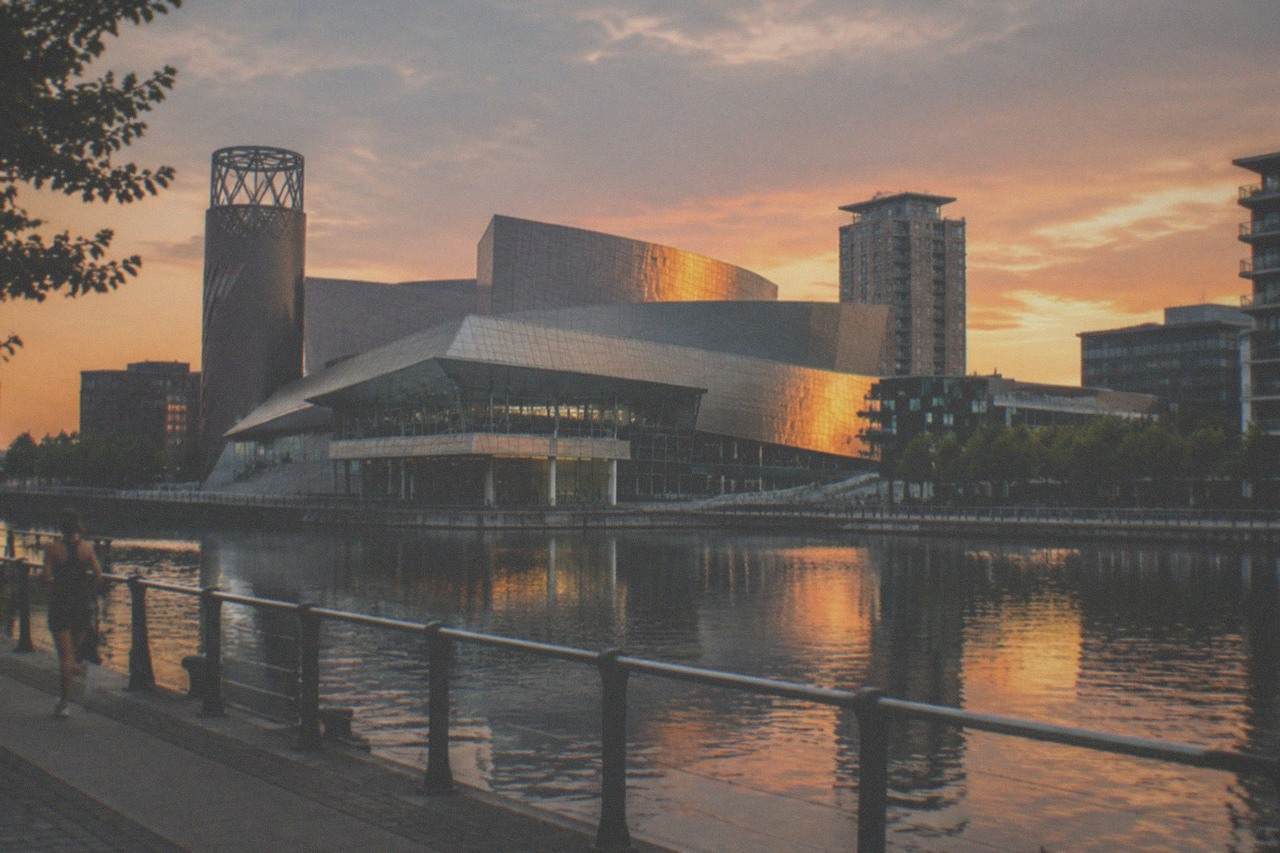
Almost. The Lowry is the current name of the venue most people still call the Lowry Centre, or the Lowry arts centre, after it opened in 2000 as part of the regeneration of Salford Quays. The building was designed by architects Michael Wilford and Partners with a stainless steel and glass facade that has divided opinion for two decades. It sits at the end of Pier 8 of the old docks, and its opening was the flagship cultural moment of the wider Salford Quays regeneration that later brought the Imperial War Museum North in 2002 and MediaCityUK from 2011 onwards.
The name does real work, though, because it trips people up in two directions. Search for the Lowry and you can land on the theatre venue, the artist L.S. Lowry, the collection, or the surrounding area's marketing. This page is about the venue at Salford Quays, named after the painter whose work fills its free galleries. The venue is not to be confused with the Lowry Outlet, the shopping centre that stood nearby for years; its status and tenancy have changed over time and no claim about it appears here, because the research behind this site has nothing verified to say about it.
For planning purposes, treat the name as one building with two offers. If the plan is galleries, the entry is free and the hours above apply. If the plan is a show, the box office and the venue's own site are the only reliable source of what is playing and what seats cost. The building's location is its own attraction either way: it juts into the water with the old docks' history all around it, and that backdrop costs nothing to stand in.
Where Is The Lowry And How Do You Get There?
The Lowry sits on the Salford side of the Manchester Ship Canal, at the heart of Salford Quays, roughly four miles from Manchester city centre as the tram runs. The simplest approach is the Metrolink: the Quays are served by the Eccles and MediaCityUK lines, with stops at Exchange Quay, Salford Quays, Anchorage, Harbour Point and MediaCityUK, all within a short walk of the building. Trams run frequently through the day, and the journey from the city centre takes around fifteen minutes. Tram and bus fares are set by Transport for Greater Manchester and change, so this page quotes none.
Walking to the Quays from the city centre is a genuinely good option and a free one in spirit. The route follows the water for much of the way, along the canal towpaths that thread through Castlefield and out towards the docks. The Rochdale Canal towpath through central Manchester is free public access, as is the Bridgewater Canal towpath at Castlefield, and from there the quayside paths at Salford Quays themselves are open public realm at all hours. Allow a good hour plus stops if walking the whole way, and treat that as an estimate of effort rather than a verified timetable.
Cyclists get the same deal: flat, waterside, continuous. Drivers do not, since parking at the Quays is paid, and that cost belongs in the budget even though nothing else on the day needs to. The free walking tours listed above all start from city centre meeting points, none from the Quays, so a walk plus a tram out to The Lowry works as a single afternoon sequence: guided morning, galleries and waterfront after.
What Else Is Free Around Salford Quays?
The Quays repay a full free day, and most of the surrounding offer carries no condition at all. The table below sets out the genuinely free attractions within walking distance of The Lowry's front door, drawn from the verified free-facts record behind this site.
| Attraction | Distance From The Lowry | What It Costs |
|---|---|---|
| Salford Quays and MediaCityUK waterfront | On the doorstep | Free public realm, open at all times |
| IWM North (Imperial War Museum North) | Around 5 minutes on foot across the canal | Free general admission |
| The Lowry galleries | The building itself | Free entry, hours condition as above |
| Bridgewater Canal towpath at Castlefield | Tram ride or a longer walk back towards town | Free public towpath |
| Ordsall Hall | Short walk south of the Quays | Free to visit, Monday to Thursday and Sundays, closed Fridays and Saturdays |
| Northern Quarter street art and Stevenson Square | Back in the city centre | Free and unrestricted to view on public streets |
Two of those deserve a sentence each. IWM North, Daniel Libeskind's shattered-earthquake of a building across the water from The Lowry, is free to enter under the Imperial War Museums group's standard admission policy, and its exhibition spaces about conflict since 1914 make it a heavyweight neighbour for a free gallery to have. Ordsall Hall, the Tudor manor house a short way south of the Quays, is free to visit on its open days, closed Fridays and Saturdays, and is one of the oldest buildings in the whole conurbation. Both sit comfortably inside a Quays day that spends nothing on admission.
The one warning worth repeating about the area: stadium tours are not free. Old Trafford sits a walk north of the Quays, and both the Old Trafford and Etihad stadium tours are paid products. Looking at the grounds from the outside costs nothing, and the Quays-side public paths give the Old Trafford area a wide berth anyway, but nobody should arrive at the Lowry hotel district expecting a free stadium interior. The football museum in the city centre, covered below, is the football fix with a free tier attached.
How Does The Lowry Compare With Manchester's Other Free Galleries?
The Lowry galleries are strong, but they are one of several free galleries within a tram ride, and the honest comparison helps a visitor decide where a day's hours go. The table compares the free tier at each of the main city galleries, with the condition stated the way the venue itself states it.
| Gallery | Free Tier | Condition |
|---|---|---|
| The Lowry galleries | Free entry including the L.S. Lowry collection | Closed Mondays except bank holidays; weekday and weekend hours differ |
| Manchester Art Gallery | Free general admission | No booking required; open Tuesday to Sunday 10am to 5pm with some late openings |
| The Whitworth | Free general admission | No booking required |
| Manchester Museum | Free entry to all galleries and exhibitions | The one current main temporary exhibition needs a booked online ticket, though the ticket itself is free |
| People's History Museum | Free entry | Voluntary £10 suggested donation, most visitors donate, admission carries no charge |
| Salford Museum and Art Gallery | Free general admission | Free tier under the council's standard offer |
Manchester Art Gallery on Mosley Street is the classic pairing with The Lowry. Its free collection spans pre-Raphaelite painting, Victorian art and early 20th century British work, and it shares The Lowry's civic-gift history: collections built by wealthy Mancunians and handed to the city. General admission is free with no booking required, and it sits in the heart of the city centre rather than out at the Quays, which makes it the easier drop-in.
Manchester Museum, on Oxford Road in the university district, is the third big hitter. Entry is free to all its galleries and exhibitions, including the South Asia Gallery and the Vivarium, and the one current main temporary exhibition is free too but requires booking a ticket online in advance. That booking condition is small but it catches people out on busy days, and it belongs in the same sentence as the free claim, which is where it sits here.
The Whitworth, in Whitworth Park a little further south along Oxford Road, is free general admission with no booking required, and its parkland setting and print collection make it a different mood again from the Lowry's industrial canvases. For a Salford-specific contrast, Salford Museum and Art Gallery itself, up the road from the Quays towards the university, carries a free general admission tier and a Victorian street reconstruction that children remember for years. The choice between them is a matter of appetite, not money, since every gallery in the table above can be walked into for nothing.
Is The Lowry A Good Free Option For Families?
Yes, with a caveat about timing. The free galleries give children the matchstick figures of Lowry's industrial scenes, which land surprisingly well with younger visitors, and the building's foyers are spacious enough that a buggy and a break are easy to manage. The L.S. Lowry collection is approachable art: no prior knowledge needed, obvious stories in the paintings, and the scale of the docks around the building makes the pictures make sense in context. A child who has just stood at the quayside where those chimneys and ships once worked will look at the canvases differently.
The caveat is Monday closure. A family weekend or bank holiday visit lands in the open hours without trouble, but a Monday inset day trip will find the galleries shut, and the nearest alternatives, IWM North and the MediaCityUK waterfront, are the backups. Across the water, IWM North is free and handles heavy subject matter thoughtfully for families, and the quayside walk itself, with the lifts and the swing bridges at MediaCityUK, is free theatre of the engineering kind.
The Children's BBC presence at MediaCityUK adds another free angle for younger visitors: the studios are working buildings, not open attractions, but the public realm around them, with the blue Peter garden and the water, is free to wander and children recognise the place from television. Food is the day's real cost at the Quays, since the cafes around the water sell at venue prices; a picnic eaten on the quayside wall is the budget move, and nothing about the free half of the day requires spending a penny inside the building.
What About The National Football Museum Free Tier?
Football is the obvious reason many visitors come to Manchester, and the free story there is more conditional than The Lowry's. The National Football Museum in the city centre is free only for Manchester City Council residents, meaning people with M postcodes who can show ID or proof of address at the door. Everyone else pays: the research record behind this site lists adult admission at £15 online or £17 walk-up, with child, concession and family saver tiers below that. Some in-museum experiences such as the Penalty Shootout cost extra on top of admission.
That resident-only condition is the sharpest conditionally-free edge in the city's museum offer, and it must never be shortened to "the National Football Museum is free." It is free for locals and paid for visitors, which for a tourism audience is the single most important sentence about the venue. Visitors from outside the M postcodes who want a free football fix are better served by the paid-free inversion elsewhere: looking at the stadiums from the outside costs nothing, and the city's football history is woven through the free walking tours, several of which pass the stories and the pubs attached to it.
For visitors weighing the £15 to £17 against the alternative, the honest comparison is this: the museum is interactive and dense, a genuinely good half day for football obsessives, while the casual fan gets more from a free walk past the city's football landmarks plus the galleries in this guide. The 3-Hour Walking Tour on GuruWalk covers city history that includes the football culture around it, and the pay what you want model lets a visitor decide the worth afterwards, which is a fitting arrangement for a city where football opinion runs hot.
How Do You Plan A Full Free Day Around The Lowry?
A workable free day at the Quays, tested against the verified free-facts record rather than guesswork, runs roughly like this. Morning in the city centre with one of the pay what you want walks above, all of which meet at central points such as St Peter's Square or the Central Library area, giving the city's story and its football, radical and industrial history. Tram out to the Quays around midday. Galleries at The Lowry in the afternoon, timing around the Monday closure and the weekday and weekend hours in the table above. Quayside walk to IWM North, which is free, then on past MediaCityUK. Evening back in town, or dinner at the Quays if the budget allows it.
Two planning notes make the day smoother. First, the timed-ticket habit: Manchester's two biggest science attractions both now use free advance booking. The Science and Industry Museum's general admission is free but a free timed ticket must be booked online in advance to manage capacity, and Manchester Museum's main temporary exhibition needs a free booked ticket too. Neither is a charge, but both are a plan, and the Science and Industry Museum's own visit page states the current arrangement. Second, the weather: the Quays are an outdoor landscape, and the free offer there leans on the waterfront walk, so the galleries and IWM North are the indoor anchors on wet days.
The day also slots into a longer Manchester itinerary cleanly. The Christmas Markets period, running Friday 6 November to Tuesday 22 December 2026 in the city's squares, adds a free-to-wander layer to a winter version of the same day, with only food and stall purchases costing money. Summer swaps that for the parks, with Heaton Park, Platt Fields and Fletcher Moss all free public green space under council maintenance. Whatever the season, the Lowry pattern holds: the art is free, the show is not, and everything outdoors around the building costs nothing at all.