Salford Quays: Free Waterfront Walks
Salford Quays is the stretch of regenerated dockland where Manchester's industrial canal system meets free museums, open waterfront promenades and a canal walking network that reaches back into the city centre.
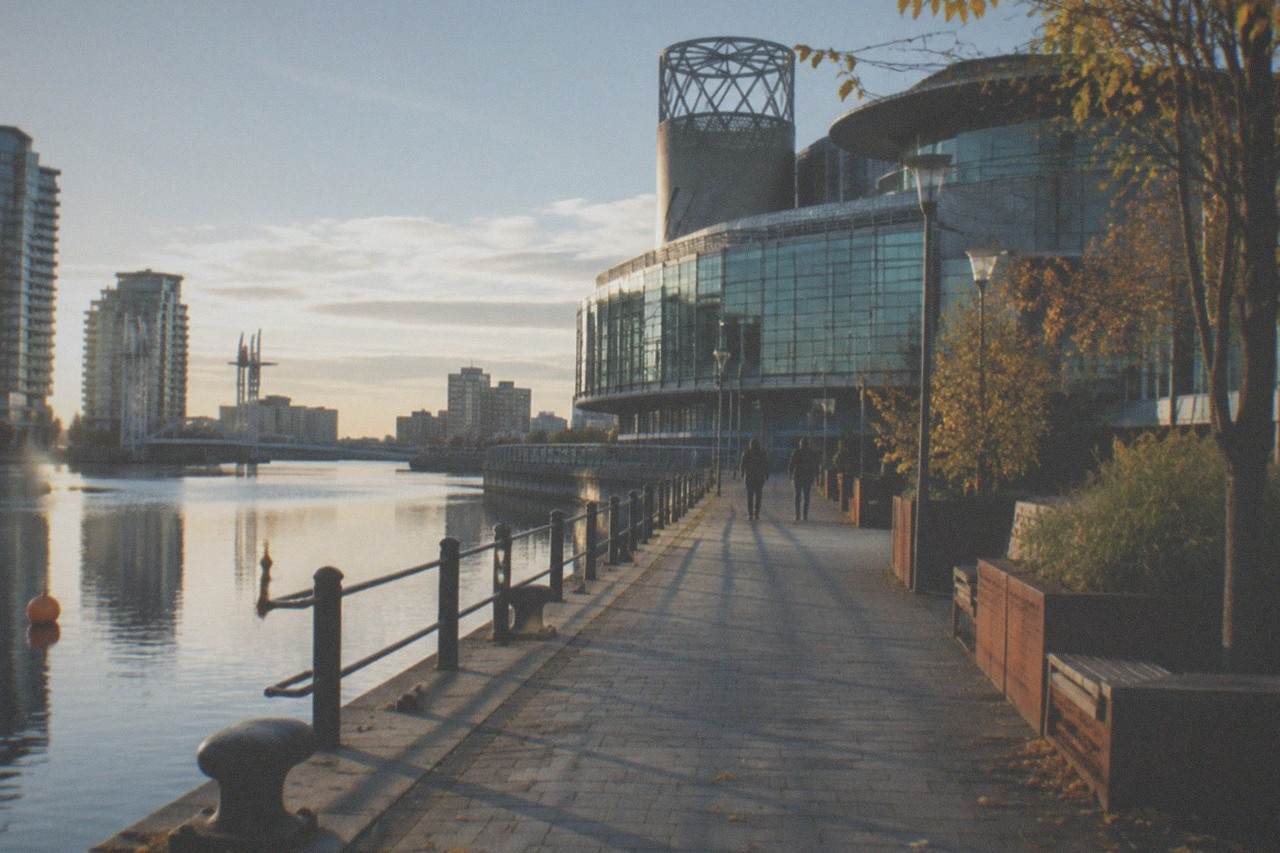
Short answer
Salford Quays is free to walk end to end, the Lowry's art galleries and IWM North are free to enter, and the whole district connects to central Manchester by free public canal towpaths.
Salford Quays costs nothing to explore on foot. The waterfront and MediaCityUK promenade are free public space at all times, the Lowry's art galleries including the L.S. Lowry collection are free to enter, IWM North has free general admission, and the Bridgewater and Rochdale canal towpaths link the docks back toward the city centre for free. Only theatre, cinema and stadium tours charge.
That is the short version. The longer version is that Salford Quays is one of the few parts of Greater Manchester where a whole day out can be assembled entirely from free components: a dockside walk, two free museums, a gallery holding the city's most famous paintings, and a canal network that turns the trip there and back into part of the visit rather than a commute. This guide sets out what is genuinely free, what is conditionally free, what is paid, and how to string it together.
The district sits on the former Manchester Docks, the inland port that closed to shipping in 1982 and was refilled and redeveloped from the late 1980s onward. What stands there now is a waterside quarter of offices, studios and cultural buildings, but the water itself, the old dock basins and the walkways around them, are public realm. Nobody charges for any of it.
Here is the free core of the district at a glance:
| What | Free status | The condition that travels with it |
|---|---|---|
| Salford Quays and MediaCityUK waterfront | Free public space | Open at all times; it is public promenade |
| The Lowry art galleries | Free entry | Galleries free, including the L.S. Lowry collection; theatre and cinema tickets are separate and paid |
| IWM North | Free general admission | Standard Imperial War Museums policy; some special events may ticket separately |
| Bridgewater Canal towpath | Free public towpath | Open public towpath, maintained by the Canal & River Trust |
| Rochdale Canal towpath | Free public towpath | Open public towpath through central Manchester |
| Castlefield heritage park | Free, open public space | Includes the reconstructed Roman fort gateway and canal basins, open at all times |
One honest note before the walking begins: this site covers free things in Manchester as a whole, and the canal-side walks that connect the centre to the Quays pass through stories a visitor would otherwise miss. The city's free walking tours are run by independent local guides on GuruWalk, a pay-what-you-want platform, and four of them run in English: the 3-Hour Walking Tour, the World-Famous Dog Salchicha Tour, the BBC And Sidemen Tour and the Radical History Tour. Each covers the industrial and canal history that explains why the docks existed in the first place. For a visitor planning a Quays day, one of these walks in the centre first turns the afternoon waterfront stroll into something with context.
Where Is Salford Quays And Why Does It Exist?
Salford Quays is the rebranded Manchester Docks, built where the Bridgewater Canal and later the Manchester Ship Canal gave inland Manchester a route to the sea. The docks operated from 1894, when the Ship Canal opened, until their closure as a working port in stages through the 1970s and final closure in 1982. The basins were drained, cleaned and refilled as part of the redevelopment, and the Lowry opened at the head of the quays in 2000, followed by the Imperial War Museum North in 2002 and the MediaCityUK broadcasting campus from 2011 onward.
That history matters to a free visitor for one simple reason: the reason this district is walkable at all is that the dock basins were preserved as water rather than filled in. The promenade loops around open water on nearly every side, and the walk along it is the single best free experience the Quays offer. A visitor arriving by tram steps out into a landscape designed around the view across the water, and the entire circuit costs nothing.
The district is technically in Salford, not Manchester, a distinction locals will cheerfully make. It is served by tram stops at MediaCityUK and Exchange Quay, both on lines through the city centre. The free option is to walk, which is where the canal towpaths come in later in this guide.
What Can You Do Free At Salford Quays And MediaCityUK?
The Salford Quays and MediaCityUK waterfront is free public realm, maintained as public promenade, and it is open at all times. There is no gate, no ticket and no charge to walk any part of it. The stroll takes in the old dock basins, the piers and quaysides, the bridges between them and the frontage of the MediaCityUK campus, where the BBC's northern studios sit alongside the water.
The waterfront rewards slow walking. The docks were built for cargo, so the quaysides are wide, and the modern additions, footbridges, planted edges and the low-set walkways around the Lowry, were designed for people on foot rather than traffic. The water is still and reflective, which is why photographers gather at the bridge crossings toward the end of the day.
MediaCityUK itself is a working campus, not a theme park. The public spaces around the studios, including the piazza where the big screens sit, are free to wander. There is no free studio tour; the paid experiences that exist there are sold separately and are outside this site's brief. But standing in the open waterfront around the studios costs nothing, and for a visitor who arrived in Manchester expecting only brick and rain, the Quays' glass-and-water geometry is a genuine change of scene.
Are The Lowry's Galleries Really Free?
Yes, with a condition worth stating precisely: the art galleries, including the L.S. Lowry collection, are free to enter, while theatre performances at the Lowry are separately ticketed and paid. The Lowry is two buildings in one, a theatre complex and a gallery complex, and only one of the two is free. The galleries, including the Andrew Law Galleries where the Lowry collection hangs, are the free half, and they hold the largest public collection of L.S. Lowry's work anywhere.
Lowry matters here more than in almost any other context. His industrial scenes of Salford and Manchester, the matchstick figures against mill walls and canal banks, are paintings of the world the Quays replaced. Seeing them a short walk from the regenerated docks is one of the more pointed free juxtapositions in the north of England: the smoke-black city he painted, viewed from the bright water that took its place. The Lowry's own visit page confirms the free gallery entry and the separate ticketing for performances.
The galleries' hours differ from the theatre's: open Tuesday to Friday 11am to 5pm, Saturday, Sunday and bank holidays 10am to 5pm, closed Mondays except bank holidays. A Monday visitor will find the doors shut, which is worth knowing before the trip out.
Is IWM North Free To Enter?
IWM North, the Imperial War Museum's northern branch, is free to enter under general admission, which is the standard policy across every Imperial War Museums site. The building alone justifies the walk: a Daniel Libeskind design intended to represent a globe shattered by conflict, its shards now one of the most recognisable silhouettes on the Quays skyline. The museum's own visit page is the source for the free-admission policy.
The condition is a mild one: free general admission covers the permanent galleries and most temporary displays, while certain special exhibitions and events carry their own tickets. A visitor checking ahead on the museum's site before travelling will never be caught out. The Main Exhibition Space covers conflict from the First World War onward with a deliberate northern emphasis, including the Home Front and the industries of the region, which ties back directly to the canal and dock history the visitor walked through to arrive.
IWM North and the Lowry stand at opposite heads of the same stretch of water, and both free halves sit within an easy waterfront wander of each other. Combined with the promenade itself, they make the Quays one of the densest free cultural districts in the region.
How Do You Walk From Castlefield To The Quays?
The most rewarding free approach to Salford Quays begins at Castlefield, the urban heritage park where Manchester's canal history is densest and oldest. Castlefield is free, open public space at all times, including the reconstructed Roman fort gateway and the canal basins. It is the spot where the Roman fort of Mamucium stood, where the Bridgewater Canal's original terminus sits beside the Rochdale Canal, and where the layering of Manchester's transport ages, Roman, canal, railway, tram, is visible in one compact area.
Walking Castlefield before the Quays gives the day its chronology. The docks at the Quays only made sense because the canals through Castlefield made inland Manchester a port in the first place. The visitor who walks from the Roman gateway past the canal basins is following the route the industrial city grew along, and the same water eventually arrives at the Ship Canal's dock basins. The route between the two districts follows canal towpath for most of its length, and it is free public walking throughout.
What Is The Bridgewater Canal Towpath Like?
The Bridgewater Canal is the oldest of the canal layers at Castlefield, and its towpath is a free public towpath, maintained by the Canal & River Trust. The Castlefield stretch runs from the basin at the heart of the heritage park outward, and it is the historic artery of the whole story: this canal, opened in 1761 to carry coal from Worsley, was the first true canal of the industrial era, and its Manchester terminus at Castlefield is where the industrial city effectively plugged itself into cheap bulk transport.
The towpath is narrow, worn in places and working heritage rather than a manicured promenade, which is exactly its appeal. Along the Castlefield stretch the path passes under the railway viaducts that were added a generation after the canal, and the 19th century architecture stacks directly overhead. The water is still the same water that carried the coal that made the mills possible, and the free walk along it is the closest thing to time travel Manchester offers.
For the Quays itinerary, the Bridgewater towpath is the connection between Castlefield's basins and the route onward. Walking it costs nothing and delivers the oldest layer of the canal story before the newest one at the docks.
What About The Rochdale Canal Towpath?
The Rochdale Canal is the second canal through the district, and its towpath through central Manchester is also a free public towpath under Canal & River Trust maintenance. Where the Bridgewater was built for coal, the Rochdale, opened through in 1804, was built to link Manchester across the Pennines to Yorkshire, and its central Manchester stretch has a character the Bridgewater lacks: it runs past the converted warehouses of the gay village on Canal Street, through locks that still work, and through some of the densest canal-side redevelopment in the city.
For the Quays day, the Rochdale towpath is the alternative stitching between the city centre and Castlefield, and the two canals meet the visitor's route in different ways. The Rochdale's central stretch is livelier, lined with bars in converted canal-side buildings, all free to walk past and expensive only if you sit down. The locks along it are among the last regularly worked broad locks in an urban setting in England, and watching one operate costs nothing but patience.
A free day built from these pieces assembles itself naturally: the Rochdale towpath out of the centre, Castlefield's basins and Roman layer in the middle, the Bridgewater and onward connection toward the Quays, and the waterfront promenade with its two free museums at the end. A plausible outline looks like this:
| Stop | Free thing | What it costs | Honest note |
|---|---|---|---|
| Central Library to Castlefield via Rochdale towpath | Free public towpath | Nothing | Lively stretch, working locks |
| Castlefield heritage park | Free public space, always open | Nothing | Roman gateway, basins, viaducts |
| Bridgewater towpath to the Quays route | Free public towpath | Nothing | Historic, narrow in places |
| Salford Quays and MediaCityUK waterfront | Free promenade | Nothing | Public realm, open at all times |
| The Lowry galleries | Free entry | Nothing | Closed Mondays except bank holidays |
| IWM North | Free general admission | Nothing | Some special events ticket separately |
No walking times are printed here because this site does not publish distances it has not verified; the route is a straight line of connected waterside paths and a visitor can extend or shorten it at any point by stepping up to street level, where the tram runs parallel to the water the whole way.
What Is Not Free At Salford Quays?
Honesty is the point of this site, so here is the paid layer, stated plainly. The Lowry's theatre and cinema tickets are paid. MediaCityUK has no free studio access; any studio or behind-the-scenes experience there is a paid product. The nearby football stadium tours, Old Trafford for Manchester United and the Etihad for Manchester City, are paid tour products, not free attractions. Water taxis, boat trips and any guided waterborne activity on the basins are commercial operations that charge.
The Quays themselves contain no free-to-access stadium, castle or paid museum trap the way central Manchester does with Chetham's Library or the National Football Museum, both of which are conditionally free or paid and covered in their own entries elsewhere on this site. The Quays' trap is milder: a visitor can arrive expecting free studio tours at MediaCityUK and find none exist. Nothing free is lost by checking ahead; only the theatre schedule and any ticketed IWM North special event need a look before setting out.
| Paid item at or near the Quays | Status |
|---|---|
| Lowry theatre and cinema tickets | Paid, separately from the free galleries |
| MediaCityUK studio experiences | Paid commercial products |
| Old Trafford stadium tour | Paid tour product |
| Etihad Stadium tour | Paid tour product |
| Boat trips and water taxis | Commercial, charge fares |
Which Free Walking Tour Pairs Best With A Quays Day?
Manchester's free walking tours all run in the centre, and a Quays-focused day pairs well with one of them either the day before or the morning of. Four English-language walks are currently bookable, all on GuruWalk, all pay what you want:
| Walk | Platform and figures | Duration | Language |
|---|---|---|---|
| 3-Hour Walking Tour | GuruWalk, rated 4.96 out of 5 across 1,276 reviews | 3 hours | English |
| World-Famous Dog Salchicha Tour | GuruWalk, rated 4.96 out of 5 across 271 reviews | 2 hours 15 | English and Spanish |
| BBC And Sidemen Tour | GuruWalk, rated 4.8 out of 5 across 256 reviews | 2 hours | English |
| Radical History Tour | GuruWalk, rated 5 out of 5 across 23 reviews | 2 hours 30 | English |
The ratings above belong to GuruWalk and are stated on its five-point scale; this site has no ratings of its own. For a Quays day specifically, the 3-Hour Walking Tour covers the broadest sweep of the city's industrial and civic story, and the Radical History Tour goes deepest on the political history that grew out of the same industrial base the docks served. Both end back in the centre with the afternoon free for the towpath walk out.
Two more walks complete the city's roster. The Express Tour in Spanish, 4.87 out of 5 across 39 GuruWalk reviews, runs in Spanish only. And the Standard Free Walking Tour, listed on freetour.com at 9.8 out of 10 from 3,530 reviews on that platform's ten-point scale, is the sixth walk in the city; its referral status here is unverified, so it is named but not linked. Those two scales are different, so the two figures are never compared directly.
The four cardable walks above are the ones this site presents; that is four featured walks out of the six that exist in the city in total.
When Is The Best Time Of Year To Walk The Quays?
The waterfront is open year-round and costs the same, which is nothing, in every season. The practical differences are daylight and what the free museums are doing. The Lowry galleries' hours run to 5pm every day they open, so in winter a visitor wanting the galleries and the promenade should do the galleries first and finish the walk in the dark, when the quayside lighting and the reflections across the basins are arguably the district's best free show. Summer days allow the reverse order, a long daylight walk ending in the galleries before close.
Wet weather is the honest northern consideration. The promenade is fully exposed to wind off the water, and there is no shelter on the walkways between the Lowry and MediaCityUK. The free half of the Lowry and the whole of IWM North are generous indoor spaces, so the standard bad-weather strategy is to make one of them the anchor and keep the outdoor stretch short. IWM North in particular is large enough that a rain-soaked hour or two disappears inside it without effort.
One seasonal note from the city's wider calendar: the Manchester Christmas Markets run from early November through late December, and while the markets are centred on the city-centre squares rather than the Quays, the canal walk to or from the Quays during that period passes a city dressed for the season. Entry to the markets is free, with only food, drink and stall purchases costing money.
Can You Do Salford Quays Entirely Without A Car?
Yes, and without spending anything on transport either, provided the walking is done on foot. The whole route described in this guide, Rochdale towpath, Castlefield, Bridgewater connection, Quays promenade, is free public walking the entire way, and the tram runs parallel to the waterfront for anyone who needs to cut a leg short. The district was rebuilt around pedestrians and trams after the docks closed, which is why the free options here are unusually good.
The visitor arriving by rail lands in the city centre, where the free attractions begin immediately, and the towpath network does the rest. Manchester Central Library, free to enter, sits within a short walk of the canal-south route out of the centre. Manchester Cathedral, with free entry and a suggested five pound donation, stands near the Rochdale's path toward Castlefield. In other words, the free day does not even start at the Quays; it starts in the middle of the city and arrives there.
For anyone who wants the day compressed, the honest statement is this: the tram is fast, paid and efficient, while the towpath is slow, free and the better experience. A day with a tight budget chooses the towpath and loses nothing but time, and time spent on a canal towpath is not usually counted as lost.
Common Questions
Is Salford Quays Free To Visit?
Yes, the waterfront and all its public promenades are free public space, open at all times. The free layer extends to the Lowry's art galleries, including the L.S. Lowry collection, and to IWM North's general admission. Only theatre and cinema tickets, studio experiences, stadium tours and boat trips cost money.
How Far Is Salford Quays From Manchester City Centre?
The district sits to the southwest of the city centre in Salford, connected by canal towpath and by tram. This site does not publish an unverified walking distance or time, but the route is a connected line of free waterside paths, with the tram running parallel throughout for anyone who wants a shorter day.
Are The Lowry Galleries Free?
Yes, the galleries, including the L.S. Lowry collection, are free to enter. The theatre and cinema within the same building are separately ticketed and paid. The galleries are open Tuesday to Friday 11am to 5pm, Saturday, Sunday and bank holidays 10am to 5pm, closed Mondays except bank holidays.
Can You Walk Along The Canals From The City Centre To The Quays?
Yes. The Rochdale Canal towpath through central Manchester and the Bridgewater Canal towpath at Castlefield are both free public towpaths, and Castlefield's urban heritage park, including the reconstructed Roman fort gateway and the canal basins, is free open public space at all times. The route links the centre to the Quays district.
Is IWM North Free?
Yes, IWM North has free general admission, which is the standard policy across every Imperial War Museums site. Some special exhibitions and events are ticketed separately, so a visitor planning around a specific display should check the museum's own site first.
Are There Free Walking Tours At Salford Quays Itself?
The free walking tours in Manchester are based in the city centre rather than at the Quays. Four English-language walks run on GuruWalk on a pay-what-you-want basis, and they cover the industrial and canal history that explains the docks. The Quays themselves are best explored alone on the free waterfront promenade.