What Is Manchester Famous For?
Manchester is famous for football, industrial firsts, music, radical politics and canals. This guide covers what made it known worldwide and the free ways to see it all.
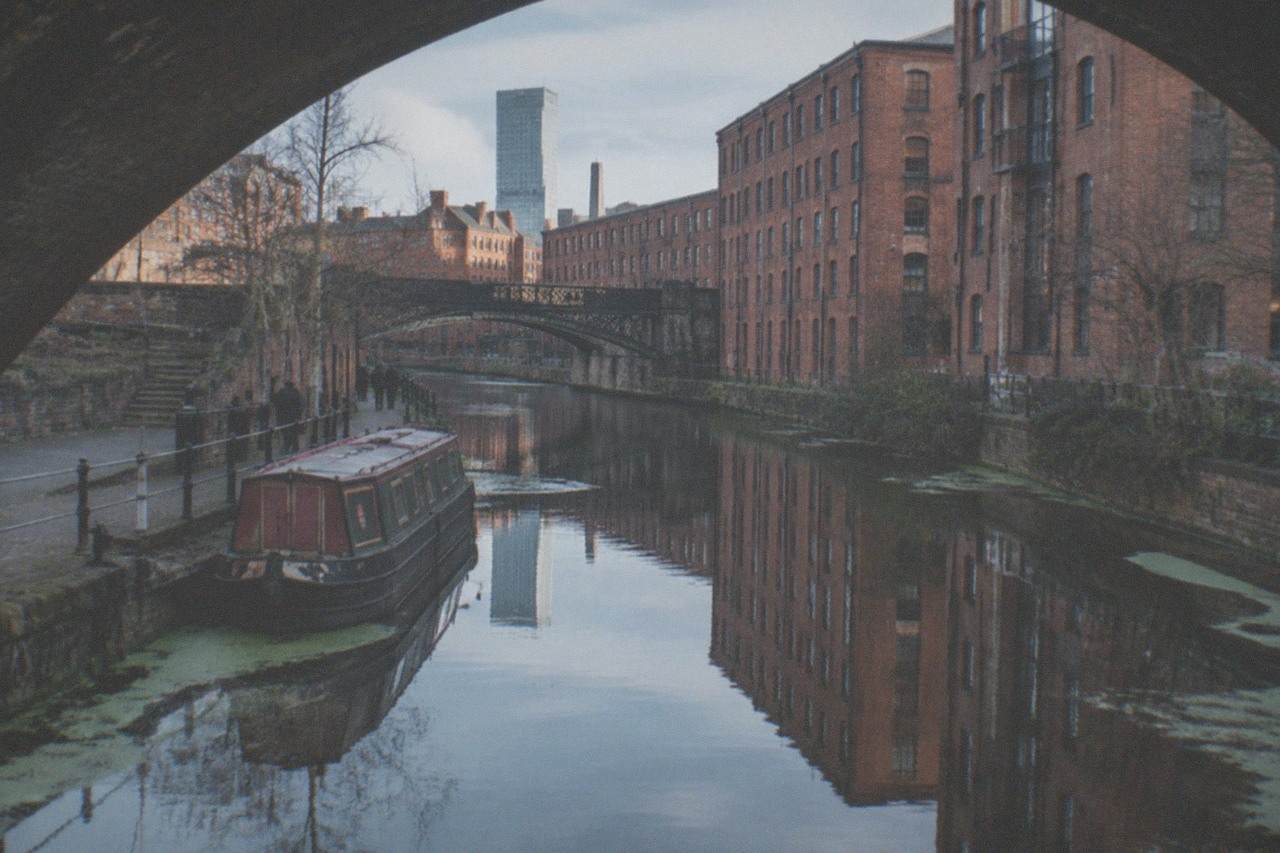
Manchester is famous for being the world's first industrial city, as the birthplace of football's modern league era through Manchester United and Manchester City, and for a run of music exports from Oasis to Joy Division. It is also known for radical politics, the ship canal, a rebuilt city centre and the gay village. Almost all of the physical evidence can be seen for free.
That last sentence matters more than it sounds. A lot of what Manchester is famous for happened in the open: in streets, canals, squares and pubs. The football legacy is visible from public roads around Old Trafford and the Etihad. The industrial firsts sit in plain sight at Castlefield, where a Roman fort, a canal basin and a railway viaduct share a few hundred metres. The music story is scattered across the Northern Quarter on plaques and murals you can simply walk up to. This guide sets out what Manchester is famous for, and the free ways to see each strand of it.
One thing to settle early. Several of the city's headline attractions are conditionally free or not free at all, and the marketing copy does not always make that clear. The National Football Museum is free only for Manchester residents with an M postcode and proof of address; everyone else pays. Manchester Town Hall has been closed to the public since 2018 for restoration. Chetham's Library, the oldest public library in the English-speaking world, is reachable only by a paid pre-booked tour. Wherever a famous Manchester sight has a catch attached, this page says so plainly.
Why Is Manchester Called The World's First Industrial City?
Manchester earned that label in the late eighteenth and early nineteenth centuries when it became the first place where factory production, steam power and a global cotton trade combined at scale. The world's first industrial suburb, Ancoats, was built here around the canals that fed the mills. Textile wealth reshaped the entire city.
The mechanics are worth a minute. Cotton arrived by canal, first via the Bridgewater Canal from 1761, which was itself a landmark: the first major English canal built as a commercial enterprise. Mill owners then clustered steam-driven spinning and weaving in Ancoats, east of today's Northern Quarter, so densely that the district is often described as the world's first industrial suburb. By the 1840s observers were calling the result "Cottonopolis."
The free evidence survives. Castlefield, where the Bridgewater Canal meets the Rochdale Canal and the Roman fort of Mamucium once stood, is an open urban heritage park you can walk through at any time with no charge. Both canal towpaths are free public paths. The red brick warehouses and railway viaducts of the Castlefield basins carry the whole story in one view, and Castlefield Viaduct, a disused railway viaduct now run as an elevated green space, is free to walk onto, open Wednesday to Sunday, 10am to 5pm, with no advance booking needed in its current phase.
What Is Manchester Famous For In Football?
Manchester is famous for two of the biggest football clubs on earth: Manchester United, formed in 1878, and Manchester City, whose 2008 takeover transformed them into a serial trophy winner. The city also hosts the National Football Museum, which holds the deepest public collection of football artefacts anywhere.
The modern game's shape is partly a Manchester invention. Newton Heath, the club that became Manchester United, formed as a railway works team in the east of the city. League football's growth ran alongside industrial Manchester, and by the twentieth century the city could claim, with only partial exaggeration, that it taught the world the sport. Old Trafford, United's ground since 1910, sits across the ship canal in Trafford, and the Etihad Stadium stands on the old Bradford Colliery site in east Manchester, next to the wider Etihad Campus.
Both stadium interiors are paid tour products. The clubs run official tours and no free public access to the pitch, stands or museums inside either stadium. What is free is the approach: the Manchester Metrolink stops at the Etihad Campus and at Old Trafford, and the surrounding public streets, statues and exteriors cost nothing to walk.
The National Football Museum in the city centre is the honest halfway point, and the condition needs stating clearly. Entry is free only for Manchester City Council residents, meaning M postcodes, with proof of ID or address at the door. Every other visitor pays: adults pay 15 pounds online or 17 pounds at the walk-up desk, with child, family and concession rates below that. It is the best football collection in the country, so it earns its place on a football pilgrimage, but it should be budgeted, not assumed free.
Which Music Is Manchester Famous For?
Manchester is famous for a chain of bands that reshaped British music, including the Hollies and the Bee Gees in the sixties, Joy Division, the Smiths and New Order through the eighties, the Stone Roses, Happy Mondays, and then Oasis and the Britpop era. The Haçienda, the nightclub that anchored the 1988 to 1997 scene, was on Whitworth Street West.
The story has a geography. The Boardwalk on Little Peter Street, where Oasis rehearsed, closed long ago. The Haçienda site is now an apartment block, but the building keeps its name and a heritage plaque marks the spot. Sifters Records in Burnage, name-checked in "Shakermaker," is still an ordinary shop in an ordinary suburb. In the Northern Quarter, murals and posters of the Manchester music canon appear and disappear on Stevenson Square and the surrounding streets, and that street art is free and unrestricted to view because it sits on public walls.
The Smiths' first rehearsal rooms, the Boardwalk, Buzzcocks' Demo-related sites and Joy Division's Macclesfield landmarks spill outside the city, but the central cluster works as a free walking theme. The Manchester Craft and Design Centre on a Northern Quarter corner has studios and shops to browse, and the building itself is free to enter. The band story is best read while walking the district rather than from any single ticketed attraction, because most of the sites are exteriors.
What Role Did Radical Politics And Protest Play?
Manchester is famous as an engine of political reform: the Peterloo Massacre of 1819, the growth of the trade union movement, the founding moment of the suffragette campaign under Emmeline Pankhurst, and the intellectual partnership of Marx and Engels, who met at Chetham's Library in 1845.
Peterloo happened on what is now St Peter's Square. On 16 August 1819 a crowd of around 60,000 gathering to demand parliamentary reform was charged by cavalry, killing at least fifteen people and injuring hundreds. The Peterloo Massacre Memorial stands in the square today, a low hill-shaped sculpture of layered names, and it is freely viewable public realm. The People's History Museum, a short walk away on the Left Bank by the river, tells the wider national story of working people's movements and is free to enter, with a voluntary ten pound suggested donation. Free entry is the permanent policy there, not a promotion.
The Pankhurst Centre on Nelson Street, where the Women's Social and Political Union was founded, keeps the suffragette flame and is open to visitors on a limited schedule, but its own admission arrangements should be checked on its official page before visiting because sessions and small charges can apply. Chetham's Library holds the desk where Marx and Engels worked, but the library is not free to visit: all access is by pre-booked paid tour, priced between 6.50 and 15.50 pounds depending on the tour, booked through the library's own box office, with no free walk-in browsing at all. The Pankhurst story and the Peterloo story are free to engage with in the streets; the interiors each carry their own terms, and pretending otherwise would mislead.
Is Manchester Famous For Its Canals And Waterways?
Yes. The Bridgewater Canal of 1761 and the 36-mile Manchester Ship Canal of 1894 are both Manchester firsts, the ship canal being the largest navigation canal ever dug at the time and the reason giant ocean ships once docked 30 miles inland. Castlefield's canal basins are the visible heart of it.
The ship canal is the staggering one. Dug between 1887 and 1894 to give Manchester a route to the sea past Liverpool's port charges, it runs from the Mersey estuary to Salford Quays, where the docks that later closed and were rebuilt as the present waterfront. Salford Quays and the MediaCityUK waterfront are free public realm today, wide open promenades around the old dock walls, with The Lowry galleries and IWM North both nearby and both free to enter (The Lowry's theatre performances are separately ticketed, the galleries including the L.S. Lowry collection are free).
The Bridgewater and Rochdale canal towpaths through central Manchester are maintained by the Canal and River Trust as free public footpaths, and the Rochdale Canal's stretch through the gay village along Canal Street is one of the most photographed free streets in the city. For a free walking route, the towpaths can be joined at Castlefield and followed out through Ancoats, tying the industrial story to the present-day city in one continuous, chargeless walk.
What Is The Northern Quarter Famous For?
The Northern Quarter is famous for its dense, unofficial street art, its independent shops and cafés, and its role as the aesthetic centre of Manchester music and skate culture since the 1990s. Stevenson Square's rotating murals and Afflecks, the multi-floor emporium of independent traders, anchor it.
The street art is the genuinely free attraction, and it is unrestricted because it lives on public walls. Murals around Stevenson Square change constantly, commissioned and unofficial alike, and the district's painted shutters have become a signature the city council actively tolerates. Afflecks itself is a building of small independent stalls, free to enter and browse, where purchases are optional.
Next door, the Manchester Craft and Design Centre occupies a former Victorian market hall and houses working studio-makers. The building is free to browse, studios sell at their own prices, and watching craftspeople at work is part of the appeal. For the football museum's famous and free alternative, note that the nearby National Football Museum falls into the conditionally free category described above. The Northern Quarter works as the free-culture end of a city where several flagship interiors charge, and it holds up on its own terms.
What Are Manchester's Famous Parks And Green Spaces?
Manchester is famous for the scale of Heaton Park in the north of the city, one of the largest municipal parks in Europe, and for Victorian-era greens such as Whitworth Park, Platt Fields Park and Alexandra Park, all maintained free and open daily.
Heaton Park spans roughly 600 acres and is free to enter, open daily from around 8am to dusk. Inside it, several normally paid or limited things sit beside the free parkland: the heritage tramway that runs through the park is a paid ride, expected back in service in summer 2026 after repairs, and Heaton Hall, the historic mansion, has limited, event-based access rather than standard opening. The Animal Centre, home to the park's farm animals, is free year-round with seasonal hours. The park also hosts the paid Parklife festival each summer, which closes parts of it temporarily, but the park itself remains a free public space.
Whitworth Park surrounds The Whitworth gallery, whose general admission is free with no booking required, making the park and the art gallery a single free outing. Platt Fields Park in Fallowfield and Alexandra Park in Moss Side are free public parks with the standard council maintenance. For something quieter still, Fletcher Moss Park and its botanical gardens in Didsbury, and Chorlton Water Park, the nature reserve on a flooded mill lodge, are both free public spaces at the calmer southern edge of the city.
What Is Manchester Famous For At Christmas?
Manchester is famous for one of the largest Christmas markets operations in Britain, spread across multiple city centre squares from mid-November to late December, with free entry and free wandering, since only food, drink and stall purchases cost money.
The 2026 run is confirmed for Friday 6 November through Tuesday 22 December, across Albert Square, St Ann's Square, Exchange Square, Cathedral Gardens, King Street, Lincoln Square, the Corn Exchange, New Cathedral Street and Market Street, with some sites extending to 3 January 2027. Dates shift year to year, so a specific year's dates should always be re-checked against the city council's announcement before travel planning. The essential free-status point is stable across years: entry to the markets and the streets they occupy is free, and the mulled wine, bratwurst and gifts are what cost money. The markets also double as a temporary lighting and decoration display, which is free to view in the same walk.
The Christmas markets sit on top of the city's permanent free layer. The Cathedral Gardens site is itself one of the free public squares listed above, and Exchange Square, Piccadilly Gardens and Cathedral Gardens form a connected free walking circuit whether the stalls are up or not. Manchester Cathedral beside Cathedral Gardens is free to enter with a five pound suggested donation, contactless accepted, and private group tours are a paid option.
Which Famous Manchester Buildings Can You Actually Get Into?
The famous exteriors are almost all free to see, but interiors vary sharply: the John Rylands Library and Manchester Central Library are free to enter, Manchester Town Hall has been closed to the public since 2018, Chetham's Library is paid-tour-only, and Victoria Baths is free only through its April to September Welcome Tuesdays.
The John Rylands Library on Deansgate is the standout free interior. Admission is free with no booking required, queues can build at busy times, and the Victorian Gothic reading room is one of the most photographed interiors in the city. Manchester Central Library on St Peter's Square is free to enter, with free access to the building and its reading rooms, and a library card is free to obtain with proof of address.
The two famous library-adjacent catches need repeating because guidebooks blur them. Chetham's Library, founded 1653 and the oldest public library in continuous use in the English-speaking world, offers no free walk-in browsing at all: every visit is a pre-booked paid tour between 6.50 and 15.50 pounds. Manchester Town Hall, the Alfred Waterhouse Gothic masterpiece, has been closed to the public since 2018 for the Our Town Hall restoration. The council has flagged a phased reopening, including a planned free Town Hall Story attraction, targeted around spring 2027, but no confirmed reopening date exists as of late 2026, so no date should be treated as settled.
Victoria Baths, the ornate 1906 swimming baths complex famous enough to have won the first BBC Restoration series, is not open to casual walk-in visitors day to day. Public access comes through Welcome Tuesday, 11am to 3pm with last entry around 2:30pm, running April to September, with free entry on a pay-what-you-can donation basis. A paid ten pound guided tour also runs. The Free Trade Hall, famous in its own right as the site of the 1908 suffragette disruption and decades of concerts, is no longer a public venue at all: the building is now a Radisson Edwardian hotel.
| Building | Access | Cost |
|---|---|---|
| John Rylands Library | Free walk-in, no booking | Free |
| Manchester Central Library | Free walk-in | Free |
| Manchester Town Hall | Closed to the public since 2018 | N/A, no confirmed reopening date |
| Chetham's Library | Pre-booked guided tour only, no walk-in browsing | £6.50 to £15.50 |
| Victoria Baths | Welcome Tuesdays only, 11am to 3pm, April to September | Free, pay-what-you-can, or a £10 guided tour |
| Free Trade Hall | No longer a public venue, now a hotel | N/A |
How Do You See All Of This Without Paying?
The most efficient free way to see what Manchester is famous for is to walk it. The city's famous strands, industrial, political, musical and football, all sit within or beside the compact city centre, and free pay-what-you-want walking tours run by independent local guides cover the same ground with the stories attached.
There are six free, pay-what-you-want walking tours of Manchester in total across the booking platforms: five on GuruWalk and one on freetour.com, of which four are featured English-language walks on this site. The 3-Hour Walking Tour, listed on GuruWalk as Free Manchester Walking Tours, is the longest option, rated 4.96 out of 5 across 1,276 GuruWalk reviews, meeting at Sackville Park and running three hours in English. The World-Famous Dog Salchicha Tour, a 2 hour 15 minute GuruWalk walk rated 4.96 out of 5 across 271 reviews, is led with the guide's celebrity dog in tow and runs in English and Spanish. The BBC And Sidemen Tour, rated 4.8 out of 5 across 256 GuruWalk reviews, is a two-hour walk that leans on the city's media fame. The Radical History Tour, rated a perfect 5 out of 5 across 23 GuruWalk reviews so far, spends two and a half hours on the Peterloo, Pankhurst and Marx side of the story.
A Spanish-only Express Tour also runs on GuruWalk, rated 4.87 out of 5 across 39 reviews, and freetour.com lists a Standard Free Walking Tour at 9.8 out of 10 across 3,530 freetour.com reviews, meeting outside Central Library. Note the two scales differ: GuruWalk scores are out of 5, freetour.com scores are out of 10, so the figures are not directly comparable.
The self-guided version costs nothing but shoe leather. Start at Castlefield for the industrial core, walk the Rochdale Canal towpath through to Canal Street, loop via St Peter's Square and the Peterloo memorial, then finish through the Northern Quarter. Every step of that route is free public space. What the paid-tour question never applies here is price: all six walks above are free to join with a pay-what-you-want tip at the end, so choosing between them is a question of theme, language and duration, never cost.